


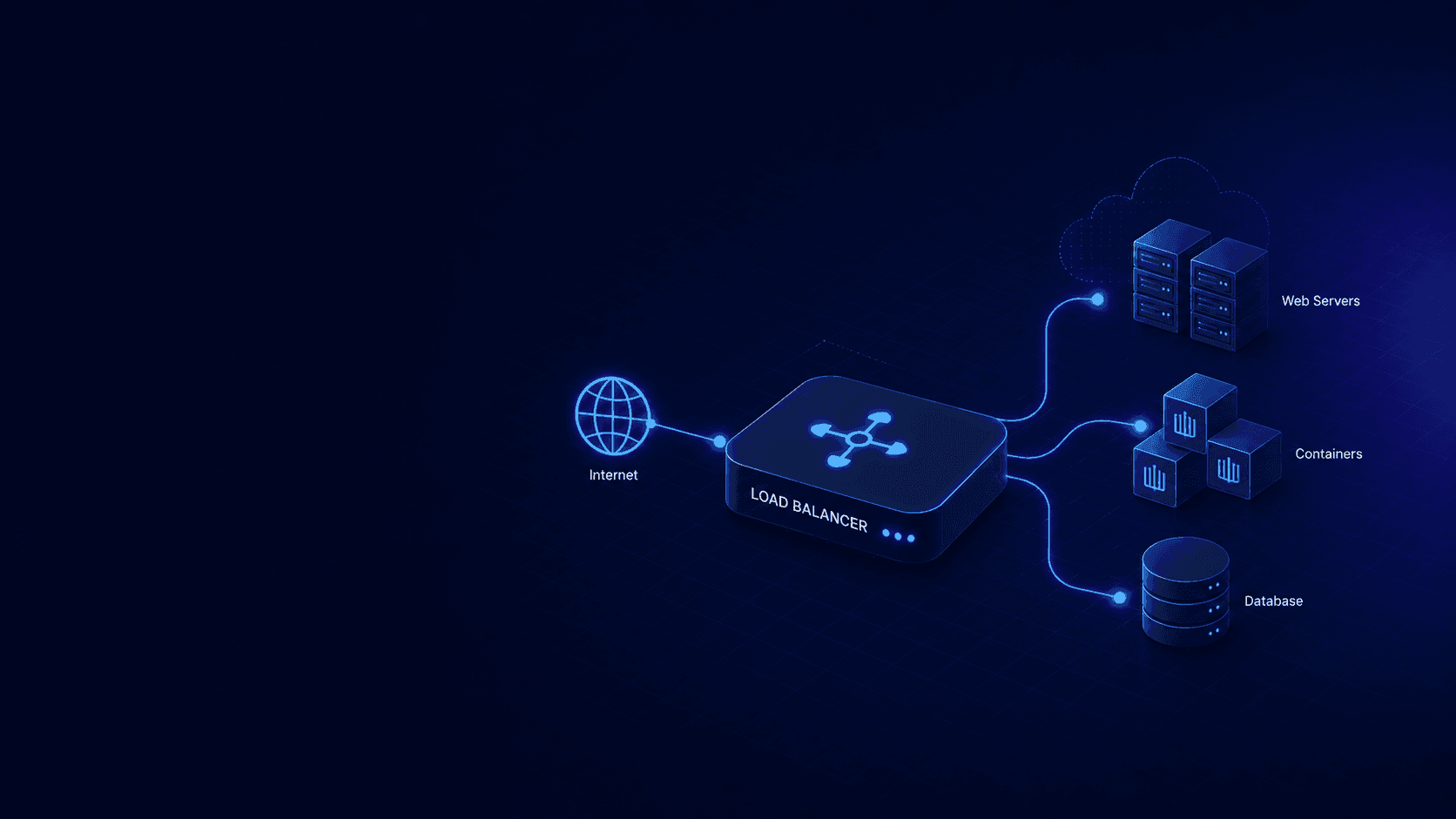
Traffic distribution with TLS that renews itself.
Layer 4 and Layer 7 load balancing across health-checked backends, with managed certificates, sticky sessions and WebSocket support. One flat monthly price, no per-request surcharge.
- L4 and L7
- Managed TLS 1.3
- 5-second health checks
- Multi-AZ pools
Load balancer pricing
A flat monthly rate that includes TLS management and health checking. Processed data beyond the included allowance is metered per gigabyte.
| Plan | Included data | Connections/sec | Monthly (AED) |
|---|---|---|---|
| LB-Standard | 2 TB | 20,000 | 79 |
| LB-Pro | 10 TB | 100,000 | 249 |
| LB-Enterprise | 40 TB | 400,000 | 749 |
| Additional processed data | per GB | – | 0.11 |
Prices exclusive of 5% UAE VAT. Managed TLS certificates, health checks and configuration changes are included at every tier.
Every request, four decisions
Nothing exotic — just the steps done correctly and consistently, every time, at whatever request volume you throw at it.
Client request
HTTPS request arrives at the load balancer's public IP.
TLS terminates
Certificate is validated and the connection is decrypted at the edge.
Routing decision
Path, host or algorithm rule picks the target backend pool.
Health-checked backend
Traffic goes only to instances that passed the last check.
Balancing behaviour you can configure
Defaults that are safe, and settings you can change when your application needs something different.
Round robin, least connections, IP hash
Pick the algorithm that suits the workload. IP hash gives session affinity without cookies where you need it.
Managed TLS
Automatic issue and renewal, or upload your own. TLS 1.3 by default with weak ciphers disabled.
Health checks
HTTP, HTTPS or TCP checks every five seconds, with configurable thresholds before a backend is pulled or restored.
Multi-AZ target pools
Spread backends across availability zones so a zone failure degrades capacity rather than causing an outage.
Path and host routing
Route /api to one pool and /static to another, or split by hostname, without running a separate reverse proxy.
Request metrics
Requests per second, latency percentiles, backend error rates and connection counts, retained and graphed.

What the load balancer does when things go wrong
High availability is mostly about how a system behaves in the bad moment, not the good ones. Here's what happens in four scenarios that come up in production.
Frequently asked questions
Yes. The load balancer issues and renews certificates automatically at no additional cost, and you can upload your own certificate or an EV certificate if your policy requires one. TLS 1.2 and 1.3 are supported; older protocols are disabled by default.
It is removed from rotation within a few seconds and traffic shifts to the remaining healthy targets. When it passes health checks again it is returned to rotation gradually rather than all at once.
Yes, on both Layer 4 and Layer 7. Idle timeout is configurable, which matters for applications that hold connections open between messages.
Yes. Target pools can span availability zones inside the region, so the loss of a single zone does not take the service down. Cross-region failover is a DNS-level design and we can set that up alongside it.