


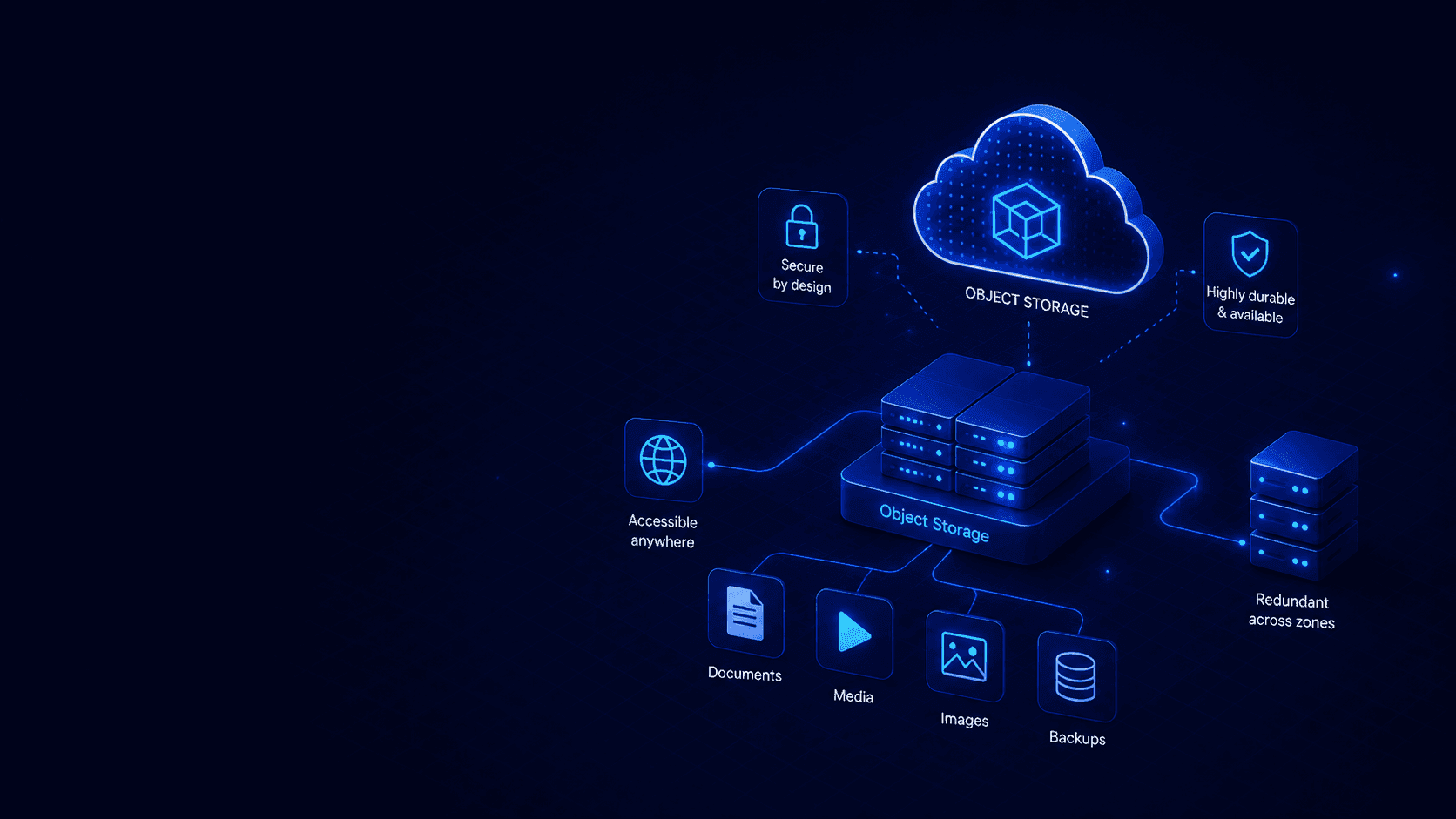
S3-compatible buckets, without the cross-border question.
Media libraries, backup targets and data lakes stored inside the UAE, addressed through the S3 API your existing tools already speak. Free ingress, free same-region transfer to your instances.
- S3 API compatible
- Versioning & object lock
- Lifecycle rules
- Free ingress
Object storage pricing
Capacity, requests and egress are billed separately so you can see what actually drives the bill. Same-region transfer to your CloudTechtiq instances is free.
| Item | Unit | Price (AED) |
|---|---|---|
| Standard storage | per GB / month | 0.075 |
| Infrequent access tier | per GB / month | 0.042 |
| Archive tier | per GB / month | 0.016 |
| Data transfer in (ingress) | per GB | Free |
| Transfer to CloudTechtiq instances, same region | per GB | Free |
| Data transfer out to internet | per GB | 0.29 |
| PUT / COPY / POST / LIST | per 1,000 requests | 0.019 |
| GET and all other requests | per 10,000 requests | 0.015 |
Prices exclusive of 5% UAE VAT. Archive tier retrieval incurs a separate per-GB fee and a minimum storage duration; both are stated in the quotation.
Objects age. Let the pricing age with them.
Set a lifecycle rule once and objects move down in cost as they get older, with no cron job or engineer required to babysit it.
Standard
0.075 AED / GBActively served objects
The default tier for anything read or written regularly — media libraries, application assets, recent backups. No retrieval fee, no minimum duration.
Infrequent access
0.042 AED / GBMonthly or quarterly reads
Older backups, compliance exports, and datasets a report touches once a quarter. Lower storage cost in exchange for a small per-GB retrieval fee.
Archive
0.016 AED / GBRarely, if ever, read
Records kept for regulatory reasons that you hope never to open again. Retrieval takes longer and costs more, but idle storage is close to free.
What you can build on it
Object storage is the cheapest durable place to put data that is written once and read many times.
Backup target
Point Veeam, Acronis, restic or bacula at a bucket. Object lock gives you immutable, ransomware-resistant retention.
Data lake
Parquet and CSV at rest, queried by Spark or Trino running on your instances in the same region at zero transfer cost.
Media and static assets
Images, video and documents served through signed URLs or a CDN, with versioning to recover an overwritten file.
Regulatory archive
Write-once retention with a defined hold period for records you are required to keep and forbidden to alter.
Lifecycle automation
Rules that move objects from standard to infrequent access to archive as they age, without anyone remembering to do it.
Access control
Bucket policies, per-key access, signed URLs with expiry, and buckets that are private unless you explicitly say otherwise.
S3-compatible means your existing tools just work
No proprietary SDK to learn. Point anything that already speaks the S3 API at a bucket, drop in an access key, and it connects — no vendor lock-in on the tooling side.
- restic
- Veeam
- Acronis
- rclone
- Cyberduck
- Duplicati
- Apache Spark
- Trino
- Terraform
- Bacula
Frequently asked questions
Yes. It implements the S3 API, so the AWS CLI, boto3, s3cmd, rclone, Veeam, MinIO clients and most backup software work by changing the endpoint. If a tool you depend on does not work, tell us which one and we will test it.
Ingress is free. Egress is metered per gigabyte and billed monthly. Traffic between object storage and your CloudTechtiq instances in the same region is free, so keeping your compute alongside your data avoids the charge entirely.
That is one of the main uses. Lifecycle rules move objects to lower-cost tiers on a schedule, versioning protects against accidental deletion, and object lock supports write-once retention for records that must not be altered.
Buckets are private by default. You can make specific objects public, issue time-limited signed URLs, or put a CDN in front. For a public website or media library we normally recommend signed URLs plus a CDN rather than an open bucket.